




























































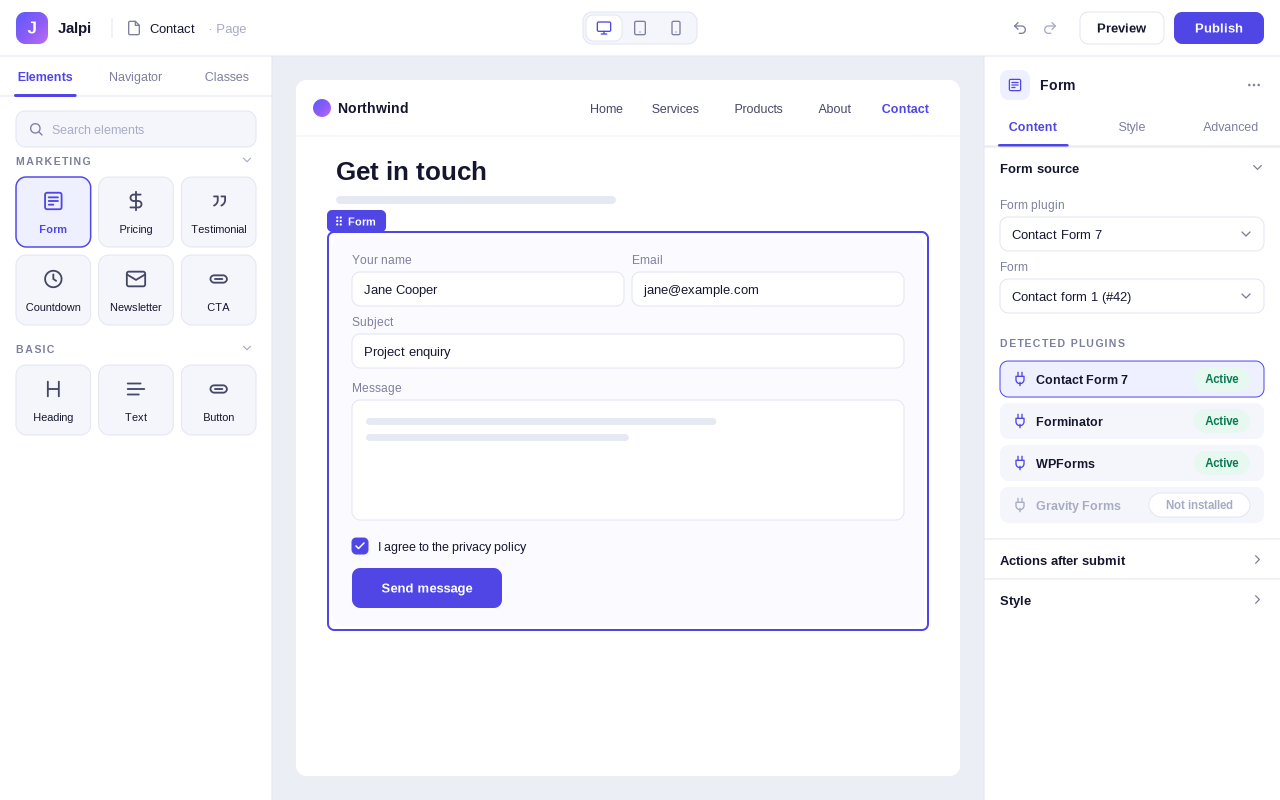
Jalpi does not implement a form builder. The Form widget embeds a form from one of four supported plugins, and everything about it is a thin bridge.
Supported plugins#
| Key | Label | Plugin file(s) |
|---|---|---|
cf7 | Contact Form 7 | contact-form-7/wp-contact-form-7.php |
forminator | Forminator | forminator/forminator.php |
wpforms | WPForms | wpforms-lite/wpforms.php or wpforms/wpforms.php |
gravityforms | Gravity Forms | gravityforms/gravityforms.php |
An array value means “any of these is sufficient”, which is how the Lite and paid WPForms builds are both detected.
Flow#
- The editor calls
GET /forms/pluginsand gets the active plugins with their labels. - Choosing one triggers
GET /forms?plugin={key}, returning that plugin’s forms as{ id, title }pairs. - The node stores only
{ plugin, form_id }. Jalpi_Element_FormcallsJalpi_Forms::render( $plugin, $form_id ), which delegates to the plugin’s own shortcode or API.
Both REST routes require edit_posts.
Forms and caching#
Form plugins embed per-request nonces, and a cached nonce is a stale nonce. Jalpi_Renderer::maybe_render_content() therefore checks:
$has_forms = class_exists( 'Jalpi_Forms' ) && Jalpi_Forms::has_form_node( $page_data['sections'] );
$use_cache = ! $has_forms && ! $has_user_tags;
has_form_node() walks the tree recursively looking for a node of type form. A page containing one is never served from the render transient.
Important
- The Form widget stores no field definitions, no submissions and no settings of its own. Everything — validation, storage, notifications, spam protection — belongs to the form plugin.
Last updated: November 2026