
Why Every Growing Business Needs an All in One Management Platform in 2026
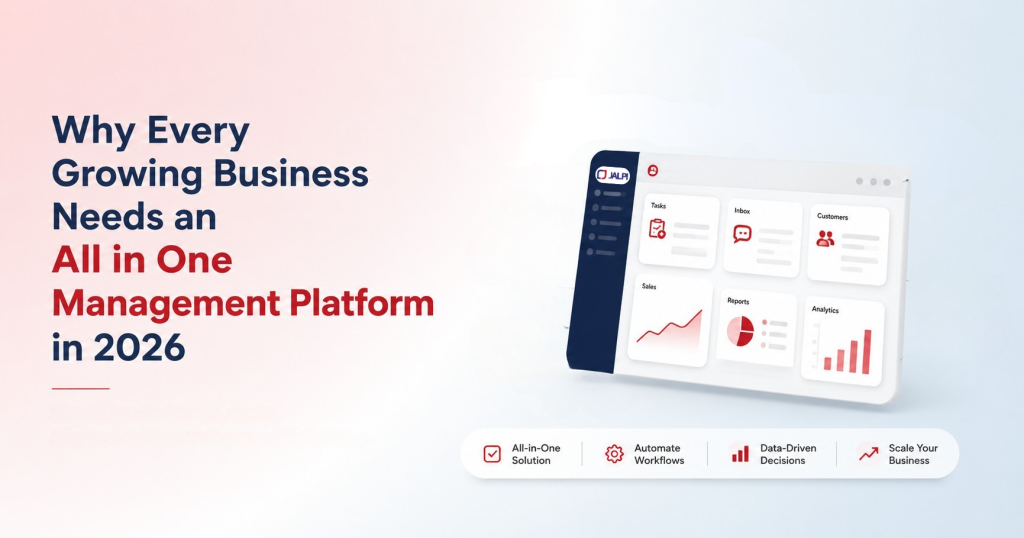
Why Every Growing Business Needs an All in One Management Platform in 2026
Growing a business is exciting. It is also incredibly difficult to manage.
The bigger your team gets, the harder it becomes to keep everyone aligned. The more customers you serve, the more communication falls through the cracks. The more projects you run simultaneously, the more tools you end up using and the more time you waste switching between them.
This is the reality most growing businesses face in 2026. Not a shortage of ambition. Not a shortage of customers. A shortage of operational clarity.
And the root cause is almost always the same: too many disconnected tools trying to do what one all in one management platform should be doing.
At Jalpi, we work with businesses across industries from emerging startups to fast-scaling SMEs and the operational pattern is consistent. Businesses that struggle with growth are almost always managing their work, their teams, their customers, and their finances across five to ten separate tools that do not talk to each other.
Businesses that grow efficiently are almost always running on a unified all in one management platform that keeps everything connected, visible, and moving forward in real time.
This blog explores:
Why growing businesses outgrow scattered tools faster than they expect
What an all in one management platform actually does and why it matters
The specific operational problems it solves for growing teams
Why 2026 is the year to consolidate onto a single platform
How to choose the right business management platform for your stage of growth
Let’s get into it.
The Hidden Cost of Managing a Growing Business With Too Many Tools
Most businesses do not start with a tool problem. They start with one spreadsheet, one email account, and one WhatsApp group. That works perfectly at five people.
At fifteen people, things start slipping. Someone does not see a task assigned in the chat. A client follow-up gets missed because it was buried in an email thread. A project deadline moves but only half the team knows about it.
At thirty people, the cost of disconnected tools becomes impossible to ignore. Managers spend hours every week in status meetings that exist only because no one has real-time visibility into what is happening. Duplicate work becomes routine. Accountability disappears because every conversation lives in a different app.
This is the exact problem that a proper all in one management platform is built to solve.
When every function of your business task management, team communication, customer tracking, workflow automation, reporting, and billing lives inside a single business management platform, the operational chaos that slows most growing businesses down simply disappears.
Work becomes visible. Accountability becomes automatic. Growth becomes manageable.
What Is an All in One Management Platform?
An all in one management platform is a unified business software system that combines multiple core business functions into a single, connected platform eliminating the need to run your operations across a dozen separate tools.
Instead of managing tasks in one tool, communication in another, customer relationships in a third, and reporting in a fourth an all in one management platform brings all of these functions together under one roof, with shared data flowing seamlessly between every module.
Think of it as the operational nervous system of your business.
A strong all in one business software solution typically combines:
Task and project management — assign, track, and complete work across your entire team
Team collaboration — communicate, share files, and coordinate within the context of every task and project
Customer relationship management (CRM) — track every customer interaction, follow-up, and deal stage
Workflow automation — eliminate repetitive manual steps with automated triggers and processes
HR and attendance management — manage team attendance, leaves, and performance in one place
Invoicing and billing — create, send, and track invoices without switching to a separate accounting tool
Analytics and reporting — real-time dashboards showing business performance across every function
When all of these capabilities live inside a single business management software solution, the result is an organization that operates with speed, clarity, and confidence at every level.
7 Reasons Why Growing Businesses Need an All in One Management Platform
1. It Eliminates the Tool Sprawl That Slows Teams Down
The average growing business in 2026 uses between 8 and 15 separate software tools to manage daily operations. Each tool has its own login, its own interface, its own learning curve, and its own subscription cost.
Every time a team member switches between tools, they lose context. Every time data has to be manually copied from one system to another, there is a risk of error. Every time a manager needs to check five different platforms to understand what is happening in the business, hours are wasted.
An all in one management platform eliminates this tool sprawl entirely. One login. One interface. One place where every function of the business lives and operates in real time.
This single change moving from scattered tools to a unified business management platform is consistently one of the highest-impact operational decisions a growing business can make.
2. It Creates Real-Time Visibility Across the Entire Business
One of the most common complaints from managers and founders of growing businesses is that they do not have a clear, real-time picture of what is happening in their organization.
Sales does not know what operations has committed to a customer. Marketing does not know which leads the sales team is following up on. Finance does not know which projects are generating billing this week.
This lack of cross-functional visibility is not a people problem. It is a systems problem. And an integrated business management system solves it directly.
When tasks, customer data, team performance, and financial activity all live in the same platform, every authorized person can see the complete picture at any moment. Managers make faster decisions. Teams stay aligned without spending half their day in meetings. Problems get identified and addressed before they escalate.
Real-time visibility is not a luxury for growing businesses. It is the foundation of operational control and an all in one management platform is what makes it possible.
3. It Automates the Repetitive Work That Drains Productivity
Every growing business has a set of repetitive processes that happen the same way, every day, every week, every month. Sending follow-up reminders. Assigning tasks when a project stage is completed. Updating customer records after a call. Generating weekly reports.
Without business workflow management software, these steps happen manually consuming time, creating errors, and diverting your team’s energy away from work that actually drives growth.
A proper business automation platform within an all-in-one system allows businesses to automate these repetitive steps entirely. Workflows trigger automatically based on preset rules. Tasks are assigned the moment previous steps are completed. Reminders go out without anyone having to remember to send them.
The result is a team that spends more time on high-value work and less time on administration a direct, measurable impact on business productivity software outcomes.
4. It Keeps Customer Relationships Organized and Nothing Gets Missed
Customer relationships are the lifeline of any business. But as a business grows, managing those relationships manually becomes impossible.
Leads fall through the cracks. Follow-ups get missed. A customer complaint logged in one channel never makes it to the team member who can resolve it. Renewal opportunities go unnoticed because no one has a system tracking them.
An all in one management platform solves this by integrating CRM directly into the same system where your team manages work and communicates. Every customer interaction inquiry, follow-up, purchase, support request, and renewal is tracked, visible, and actionable from a single dashboard.
For growing businesses managing hundreds or thousands of customer relationships simultaneously, this integrated approach is not optional. It is the difference between retaining customers and losing them to competitors who communicate faster and more reliably.
5. It Makes Growing Teams More Accountable Without Micromanagement
As businesses grow beyond 15 to 20 people, management becomes exponentially harder. A founder or manager cannot personally track every task, follow up on every deadline, or check in with every team member every day.
Without a proper system, accountability disappears. Tasks are assigned in conversations and forgotten. Deadlines shift without formal tracking. Team members genuinely do not know whether their contribution is on track or falling behind.
Business operations management software built into an all-in-one platform solves this by making accountability automatic. Every task has an owner, a deadline, and a visible status. Overdue notifications trigger automatically. Managers can see the state of every ongoing project without scheduling a meeting.
This shift from informal accountability to system-enforced accountability is one of the most transformative changes a growing business can make. And it happens naturally when the right all in one management platform is in place.
6. It Significantly Reduces Software Costs as You Scale
Managing a growing business across 10 separate tools is not just operationally inefficient. It is expensive.
The average business using separate tools for project management, communication, CRM, HR, invoicing, and analytics spends significantly more per team member than businesses running on a single consolidated all in one business software solution.
Beyond the direct subscription costs, there are hidden costs that most businesses underestimate: the time spent onboarding new team members to multiple platforms, the IT overhead of managing multiple integrations, and the productivity cost of tool-switching throughout the day.
An all in one management platform consolidates these costs into a single, predictable investment and as your team grows, the savings compound. Every new team member you add to a unified platform costs less to onboard and less to support than adding them to a fragmented multi-tool stack.
For small business management software buyers in particular, this consolidation effect can cut software costs by 30 to 60 percent while simultaneously improving operational performance.
7. It Gives You the Infrastructure to Scale Without Chaos
The most dangerous moment for a growing business is the transition from “startup mode” to “operating at scale.”
In startup mode, informal coordination works because the team is small, communication is frequent, and the founder can personally oversee everything. At scale, that model breaks. Teams become too large for informal management. Projects become too complex for chat-based coordination. Customers become too numerous for manual follow-up.
Businesses that try to scale without the right business management software infrastructure consistently hit a wall. Growth slows, not because of lack of demand, but because the internal operations cannot support it.
An all in one management platform is the infrastructure that removes this ceiling. It gives your business the systems, visibility, accountability, and automation needed to grow from 20 people to 100 to 500 without losing operational control at any stage.
This is exactly why the world’s fastest-growing businesses invest in a unified business management platform early because the cost of doing it later, after growth has exposed all the operational cracks, is always higher.
What to Look for in the Best All in One Management Platform
Not every all in one business software delivers on its promise. Here is what to evaluate before choosing:
Comprehensive Feature Coverage
The platform should cover all core business functions task management, team collaboration, CRM, HR, invoicing, workflow automation, and analytics — without requiring separate subscriptions for each capability.
Ease of Use and Adoption
The best business management software is powerful and simple. If your team needs weeks of training to use it, adoption will be low and the investment will not deliver its full value. Prioritize platforms with intuitive interfaces that every team member can navigate from day one.
Workflow Automation Capabilities
Your business automation platform should allow you to automate recurring processes without requiring technical expertise. Look for no-code automation builders that let your operations team design workflows without IT support.
Real-Time Reporting and Dashboards
Strong business productivity software provides real-time dashboards that give founders, managers, and team leads complete visibility into performance across every function — without running manual reports.
Scalability
Choose a platform that grows with your business. The right integrated business management system should perform just as well at 200 users as it does at 20 — without requiring a platform migration as you scale.
Integration Capability
Your business operations management software should connect with the external tools you already rely on — communication platforms, payment gateways, e-commerce tools, and marketing channels — creating a truly connected operational ecosystem.
Security and Data Control
As your business stores increasing amounts of sensitive data in a single platform, security becomes critical. Look for enterprise-grade data encryption, role-based access controls, and reliable backup systems.
How Jalpi's All in One Management Platform Supports Growing Businesses
At Jalpi, we built our all in one management platform specifically for the challenges growing businesses face not the challenges of enterprise corporations or individual freelancers, but the messy, fast-moving reality of businesses scaling from 10 to 100 to 1,000 people.
Jalpi brings together the core capabilities every growing business needs in a single, connected platform:
Task Management — assign, track, and complete work with clear ownership, deadlines, and real-time status updates
Team Communication — structured collaboration built directly inside every task and project
WhatsApp Business API — manage customer communication through India’s most-used messaging platform, integrated directly into your business workflows
CRM and Lead Management — track every customer interaction, follow-up, and deal from inquiry to conversion
HRMS — attendance tracking, leave management, and employee records in one place
Invoicing and Billing — create, send, and track invoices without switching tools
Workflow Automation — automate recurring processes with no-code triggers and actions
Analytics Dashboard — real-time business performance reporting across every function
What makes Jalpi different from other business management platforms is how deeply these capabilities are connected. Task completion triggers a CRM update. A customer message through WhatsApp automatically creates a task for the responsible team member. An invoice is generated from a completed project record without manual data entry.
This level of operational integration is what transforms a collection of features into a genuine all in one management platform and it is what gives Jalpi-powered businesses the speed, clarity, and accountability they need to grow.
The Cost of Waiting: Why 2026 Is the Year to Consolidate
Every month a growing business operates on a fragmented tool stack is a month of lost productivity, missed opportunities, and preventable errors.
The businesses that move to a unified all in one management platform early gain a compounding operational advantage. Their teams are more productive. Their customers are better served. Their managers make faster decisions. And their cost-per-operation decreases as scale increases.
The businesses that wait that keep adding tools to patch operational gaps instead of solving the root problem. find that by the time they are ready to consolidate, the migration is more complex, the data cleanup is more expensive, and the team change management is harder.
2026 is the year to act. India’s business landscape is moving faster than ever. Competition is more intense. Customer expectations are higher. And the businesses investing now in the right business management software infrastructure will be the ones that look back in three years and understand exactly why their growth accelerated when it did.
Conclusion: Build a Smarter, Faster, More Accountable Business With an All in One Management Platform
Growing a business is hard. Managing it does not have to be.
When your tasks, your team, your customers, your workflows, and your reporting all live inside a single all in one management platform, the operational friction that slows most businesses down simply disappears.
Work gets done faster. Nothing falls through the cracks. Accountability is automatic. And your business has the operational foundation to grow without limits.
The right all in one management platform delivers:
A unified view of every function of your business in real time
Automatic accountability for every task, deadline, and responsibility
Workflow automation that eliminates hours of manual administration every week
Customer relationships that are organized, tracked, and never missed
The scalable integrated business management system infrastructure that growing businesses need
If your business is still managing growth across a dozen disconnected tools, the most important step you can take today is consolidating onto a single, powerful business management platform that connects everything.
Explore how Jalpi’s all in one management platform helps growing businesses work smarter, serve customers better, and scale faster every single day.
Frequently Asked Questions
An all in one management platform is a unified business software system that combines multiple core business functions including task management, team collaboration, CRM, HR, invoicing, workflow automation, and analytics into a single connected platform. Instead of managing operations across many separate tools, businesses run everything from one system with shared data and real-time visibility.
Growing businesses need an all in one management platform because operational complexity increases faster than informal systems can handle. As teams grow and projects multiply, disconnected tools create visibility gaps, accountability failures, and productivity losses. A unified business management platform eliminates these problems by connecting every function of the business in one place.
Project management software handles task assignment and project tracking. A business management platform is broader. it integrates project management with CRM, HR, invoicing, workflow automation, communication, and analytics, creating a complete operational system rather than a single-function tool.
All in one business software saves money by replacing multiple separate subscriptions with a single platform investment. It also reduces hidden costs like multi-tool onboarding time, IT integration overhead, and productivity losses from tool-switching. For small business management software buyers especially, consolidation can cut software costs by 30 to 60 percent.
Look for task and project management, team collaboration tools, CRM, HR and attendance management, invoicing, workflow automation, real-time reporting dashboards, mobile access, integration capability, and strong data security. The best business operations management software combines all of these in one intuitive, scalable system.
A business automation platform allows businesses to automate repetitive processes like task assignment, follow-up reminders, status updates, and report generation based on preset rules. This saves hours of manual work every week, reduces errors, and ensures consistent execution across the entire organization.
Yes. Small business management software that consolidates operations into a single platform is especially valuable for small and growing businesses that cannot afford large IT teams or complex multi-tool integrations. A unified platform gives small businesses enterprise-level operational clarity without enterprise-level complexity or cost.
An integrated business management system creates automatic accountability by giving every task a clear owner, deadline, and visible status. Automated overdue notifications replace manual follow-ups. Managers have real-time visibility into every ongoing project without scheduling check-in meetings — making accountability a system feature rather than a management effort.
Business workflow management software is the automation layer within a management platform that defines, executes, and monitors how work moves through your organization. It ensures tasks flow through the right sequence of steps, triggers automatic actions when conditions are met, and eliminates bottlenecks that slow down business operations.