

Best Business Process Automation Strategies for SMEs in 2026
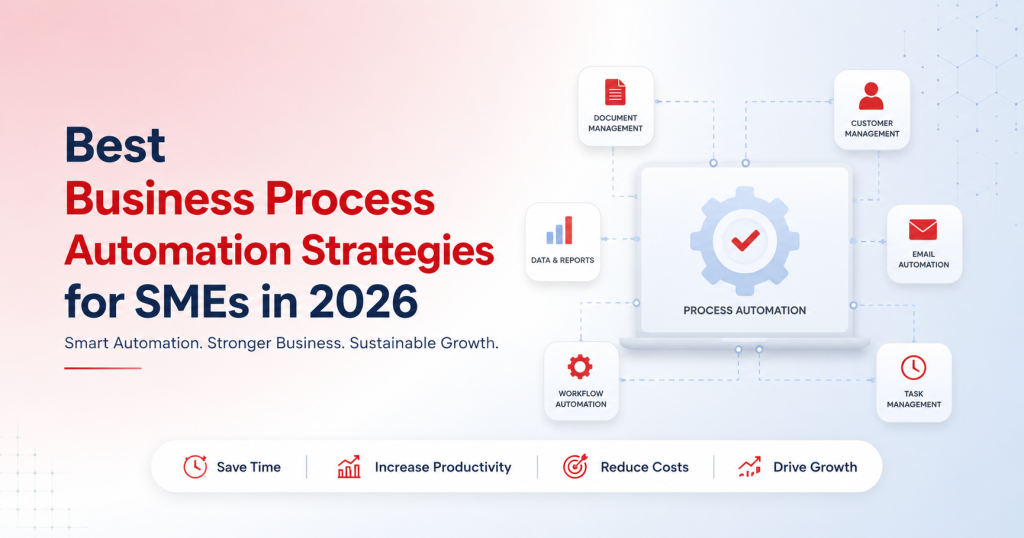
Best Business Process Automation Strategies for SMEs in 2026
Most small and mid-sized businesses lose hours every day to work that shouldn’t need a human at all.
Manually typing out payment reminders. Copying customer details from a form into a spreadsheet. Building the same weekly report from scratch. Assigning a task through a WhatsApp message and hoping the right person actually sees it.
None of this is strategic work. It’s repetitive, low-value activity that eats into the time your team should be spending on selling, serving customers, and growing the business.
This is exactly the gap Business Process Automation is built to close.
In 2026, Business Process Automation isn’t a large-enterprise technology anymore. Affordable, purpose-built automation tools are now available to small and mid-sized businesses that want to run leaner without hiring more people just to keep up with admin work.
At Jalpi, we’ve watched this shift happen across thousands of SMEs. The businesses that automate early build a compounding operational edge. The ones that wait keep doing manual work while their competitors pull ahead.
In this article, you’ll find:
What Business Process Automation actually means for SMEs
Why 2026 is a pivotal year for SME automation
Seven practical automation strategies you can implement now
How to evaluate Business Automation Software for your stage of growth
A full FAQ section at the end
Let’s get into it.
What Is Business Process Automation And Why Does It Matter for SMEs?
Business Process Automation is the use of technology to run recurring business tasks and workflows automatically, without a person having to trigger every step by hand.
Instead of a team member manually typing out a payment reminder, the system sends it at the right time on its own. Instead of a manager remembering to assign a follow-up task after every sales call, the task is created and assigned the moment the call is logged. Instead of an HR executive tallying attendance every morning, the system records and calculates it in real time.
Business Process Automation replaces the manual effort behind these steps with rule-based systems that run consistently, accurately, and at scale.
Large enterprises have automated their operations for over a decade. What’s changed is that Business Process Automation for SMEs has become genuinely accessible in 2026 the cost and complexity of implementing it have dropped sharply.
Modern Business Automation Software like Jalpi doesn’t require coding knowledge, expensive consultants, or a months-long rollout. It’s built for the people who understand the process business owners and operations managers not developers, so automations can go live in hours.
For SMEs running lean teams on tight budgets, Business Process Automation isn’t a nice-to-have tech upgrade. It’s a growth strategy.
Why 2026 Is a Critical Year for SME Automation
Three trends are converging in 2026 that make this the right moment for SMEs to invest in automation.
1. Automation has become more capable. Modern Business Automation Software can now handle messier, less structured inputs. a customer’s WhatsApp message, an order query, a support request and route or respond to them automatically. Work that once needed custom development is now a standard feature on SME platforms.
2. Larger competitors are pulling ahead operationally. Bigger businesses are running automated sales follow-ups, HR processes, and customer communication. SMEs still relying on manual work are competing at a structural disadvantage. Business Process Automation for SMEs is what closes that gap.
3. Customers expect faster, more consistent responses. In 2026, customers expect instant acknowledgements, real-time order updates, and follow-through that doesn’t depend on who’s in the office that day. A Customer Communication Platform built around channels like WhatsApp, SMS, and RCS is what lets a 10-person team deliver the kind of responsiveness that used to require a much bigger one.
Businesses that start automating now build an advantage that compounds over the next few years. The ones that wait will find that gap harder to close every quarter.
Best Business Process Automation Strategies for SMEs in 2026
Strategy 1 — Automate Customer Communication and Follow-Ups
The single highest-impact area of Business Process Automation for most SMEs is customer communication.
Every business has touchpoints that repeat the same way, every time: acknowledging an inquiry, following up on a quotation, confirming an order, sending a payment reminder, sharing a delivery update, requesting feedback. None of these need human judgment they need to happen on time, every time.
Example: A home decor retailer gets 40 WhatsApp inquiries a day about product availability. Left to manual replies, half go unanswered within the hour. With an automated acknowledgement and FAQ flow in place, every inquiry gets a response in under a minute and only the ones that genuinely need a salesperson get escalated.
How Jalpi solves this: Jalpi’s WhatsApp Business API lets you build rule-based message sequences inquiry acknowledgement, order confirmation, delivery updates that fire automatically the moment a trigger happens. Layer in SMS and RCS for richer, interactive messages (buttons, images, order tracking cards), and Mail Tracker to see exactly when a follow-up email has been opened so you know when a human touch is actually needed.
How to implement this strategy:
Map every recurring customer touchpoint in your business
Define the trigger for each message (inquiry received, payment due, order shipped)
Build the sequences inside your WhatsApp Business API setup so each trigger fires the right message automatically
Combine WhatsApp, SMS, and email into one coordinated communication flow
Set an escalation rule if a customer doesn’t respond within 48 hours, notify the responsible team member
Implementation tip: Start with your highest-volume touchpoint only usually inquiry acknowledgement before automating the rest. It’s the fastest way to prove impact without overhauling every process at once.
Impact: SMEs that automate customer communication typically report a meaningful drop in manual follow-up time and noticeably higher response rates once replies become instant and consistent.
Strategy 2 — Automate Task Assignment and Team Workflow Routing
Manual task assignment quietly drains more SME productivity than almost anything else.
A new lead comes in someone has to remember to assign it. A project moves to the next stage someone has to create and hand off the follow-on tasks. A complaint lands in the inbox someone has to decide who handles it. Every one of these is a manual interruption pulling a manager away from higher-value work.
Example: A marketing agency with 12 account managers used to lose half a day every week just reassigning tasks after client calls. Once task creation was tied directly to call logging, assignments happened instantly no manager involvement required.
How Jalpi solves this: Jalpi’s Task Management Software lets you set rule-based assignment logic directly into your workflows. when a new lead is logged, a project moves stages, or a complaint is filed, the right task is created and routed to the right person automatically, with a deadline attached.
How to implement this strategy:
Document every recurring task-assignment process in your business
Identify the trigger for each one (lead received, stage changed, form submitted)
Set up automated routing rules inside Task Management so assignments happen without manual input
Configure automatic deadlines based on task type and priority
Add an escalation rule so unaccepted tasks notify a manager after a set period
Implementation tip: Start by automating deadline assignment before you automate the routing logic itself — it’s the simplest change and immediately makes accountability visible across the team.
Strategy 3 — Automate Invoicing, Billing, and Payment Follow-Ups
For most SMEs, invoicing and collections are still a manual, error-prone slog. Invoices get created one at a time, sent individually, and followed up inconsistently — which is exactly why payments come in late.
Business Process Automation changes this at the root.
Example: A B2B distributor invoicing 200 clients a month was manually tracking who’d paid in a spreadsheet. After automating reminders and receipt confirmations, overdue invoices dropped by more than a third within two billing cycles — simply because no reminder was ever missed.
How Jalpi solves this: Jalpi’s Invoice Management System generates invoices automatically against milestones or recurring billing dates, sends payment reminders on a defined schedule, and logs receipt confirmations the moment a payment comes in closing the loop without manual data entry.
How to implement this strategy:
Connect invoice generation to project milestones or recurring billing dates inside your Invoice Management System
Set up escalating payment reminders a gentle nudge at day 7, a firmer one at day 14, escalation to an accounts manager at day 21
Automate payment receipt acknowledgements so customers get instant confirmation
Review invoice and payment status through built-in real-time reporting instead of a manual spreadsheet
Implementation tip: Set your first reminder earlier than feels necessary day 3 instead of day 7. Most late payments are simply forgotten, not disputed, and an early nudge resolves the majority of them.
For SMEs managing 50 to 500 active clients, automating billing this way can recover hundreds of hours a year and meaningfully improve cash flow.
Strategy 4 — Automate HR, Attendance, and Leave Management
HR administration is one of the most time-intensive and most automatable functions in any SME.
Daily attendance, leave approvals, payroll calculation, and compliance reporting all follow defined rules. They don’t need judgment every time; they need accurate, consistent execution.
Example: A 40-person logistics company used to spend two full days each month reconciling attendance registers against payroll. Digitizing attendance tracking and tying it directly to payroll calculation cut that to a few hours and eliminated the calculation errors that used to trigger salary disputes.
How Jalpi solves this: Jalpi’s HRMS Software replaces manual registers with real-time digital attendance tracking, routes leave requests through automated approval workflows, and feeds attendance and leave data directly into payroll calculations cutting out manual reconciliation entirely.
How to implement this strategy:
Move attendance tracking to a digital, real-time system inside your HRMS
Build leave-approval workflows that notify both the requester and manager automatically
Tie payroll calculation to attendance and leave data to reduce manual errors
Set compliance reminders for statutory deadlines like PF filings and TDS calculations
Implementation tip: Digitize attendance first. It’s the input every other HR automation depends on, and it delivers a visible time saving within the first week.
Automating HR this way typically cuts time spent on attendance and leave administration dramatically, while sharply reducing payroll calculation errors. It’s especially valuable for SMEs with 15 to 100 employees big enough that informal tracking breaks down, not yet big enough to justify a dedicated HR administrator.
Strategy 5 — Automate Lead Capture and Follow-Up Routing
Most SMEs don’t lose leads because of a weak product or poor sales skills they lose them to slow response times and inconsistent follow-up after the first inquiry.
Leads contacted within 5 minutes convert at dramatically higher rates than leads contacted after 30. For a team managing inquiries manually, a 5-minute response is nearly impossible. With Lead Management Automation, it’s the default.
Example: A real estate brokerage was losing website leads overnight because inquiries only got checked the next morning. After automating instant acknowledgement and same-hour routing to an available agent, response time dropped from an average of 14 hours to under 3 minutes.
How Jalpi solves this: Jalpi’s Forms product captures leads from your website with built-in validation, feeding straight into your workflow without manual re-entry. From there, the WhatsApp Business API sends an instant acknowledgement, and Task Management routes the lead to the right salesperson and schedules the follow-up sequence automatically. If your team already runs a CRM, Jalpi’s Zoho CRM integration lets WhatsApp conversations and lead updates sync directly into it without Jalpi needing to replace your CRM.
How to implement this strategy:
Set up automated lead capture from your website using Forms, feeding directly into your workflow without manual data entry
Trigger an automatic acknowledgement message to every new lead within 60 seconds via WhatsApp Business API
Route leads automatically to the right salesperson through Task Management, based on source, product interest, or location
If you use a CRM, sync lead activity automatically via CRM integration instead of double-entering data
Set automated follow-up touchpoints — day 1, day 3, day 7 for leads that haven’t responded
Implementation tip: Automate the acknowledgement message before anything else. It’s the single change with the biggest effect on conversion, and it takes the least time to set up.
Lead Management Automation tends to be the highest-ROI investment on this list, because it directly affects revenue rather than just cost.
Strategy 6 — Automate Reporting and Business Visibility
Founders and managers at SMEs spend a surprising amount of time assembling reports that could just generate themselves.
Sales performance summaries, team productivity reports, invoice and payment status, attendance and payroll snapshots most of these pull from the same handful of systems and go to the same people on the same schedule every week or month.
Example: An operations manager at a 25-person e-commerce brand used to spend every Monday morning manually pulling numbers from four different spreadsheets into one summary. Once those numbers lived inside the same platform running tasks, invoicing, and HR, the report assembled itself.
How Jalpi solves this: Rather than a bolt-on reporting tool, real-time dashboards are built into each Jalpi product. Task Management shows live project and productivity status, HRMS shows attendance and payroll data, Invoice Management System shows outstanding and collected payments, and Support Ticket (Jalpi Desk) shows resolution performance. Because they run on the same platform, a manager can check business health across functions without stitching together separate exports.
How to implement this strategy:
Identify the handful of metrics each stakeholder actually needs sales activity for the sales lead, task completion for operations, cash flow for finance
Use each product’s built-in dashboard instead of manually rebuilding the same report every cycle
Set threshold-based alerts where available for example, flagging overdue invoices or a drop in task completion rate
Review dashboards on a fixed cadence (weekly for operational metrics, monthly for financial ones) so reporting becomes a five-minute check-in, not a half-day task
Implementation tip: Pick one dashboard to replace one recurring manual report first. Once the team trusts the live numbers, expanding to the rest becomes an easy sell.
Strategy 7 — Automate Customer Support and Query Resolution
Customer support is one of the most resource-intensive functions in an SME and one of the most automatable.
Most support queries fall into a handful of recurring categories: order status, payment confirmation, product information, complaint logging, and appointment scheduling. Each of these can be handled automatically at first contact, freeing your support team to focus on the complex cases that genuinely need a human.
Example: A beauty brand’s support inbox was dominated by “where’s my order” messages. After automating order-status replies through WhatsApp and routing anything more complex into a ticketing queue, the support team’s manual workload dropped by more than half within a month.
How Jalpi solves this: Jalpi’s Support Ticket (Jalpi Desk) centralizes every query, automates SLA tracking, and gives you real-time resolution analytics. Pair it with automated FAQ and order-status replies through WhatsApp Business API, and route voice queries automatically with Cloud IVR. so only the interactions that need human judgment ever reach your support team.
How to implement this strategy:
Build automated responses for your 10 most common customer queries through WhatsApp Business API
Trigger automated order-status updates at each stage of fulfillment
Log every complaint automatically in Support Ticket, with an instant acknowledgement and a resolution deadline attached
Set SLA-based escalation so unresolved complaints move up automatically
Route inbound calls through Cloud IVR so simple queries are handled without tying up a support agent
Implementation tip: Start by automating your top 3 FAQ answers only. It’s a low-risk way to test the flow before automating your full query volume.
Support teams that automate their top recurring queries this way commonly resolve 50–70% of incoming volume without any human involvement cutting response times while reducing team workload.
How to Choose the Right Business Automation Software for Your SME
With so many Business Automation Software options on the market, a few factors matter more than the rest when you’re evaluating fit for an SME.
Ease of implementation. The best platforms are built for business owners and operations managers, not developers. Look for tools that let you configure rules and triggers yourself, without IT support or a lengthy onboarding project.
Coverage across business functions. Choose software that covers the areas that matter most to you customer communication, task management, HR, invoicing, and support ideally within one platform, so automations in one area can trigger actions in another.
Scalability. Your Business Automation Software should grow with you. A platform handling 10 users today shouldn’t need a migration to handle 100 tomorrow.
Integration capability. Your platform should connect to the tools you already use -WhatsApp, email, payment systems, and CRMs like Zoho — extending automation across every touchpoint instead of creating another data silo.
Real-time visibility. Automation only delivers value you can see. Choose a platform with live dashboards showing performance and exceptions, not just a monthly export.
Transparent, predictable pricing. For SMEs, cost predictability matters as much as features. Look for usage-based or per-user pricing that scales with your business, without a surprise jump to an “enterprise tier” the moment you grow.
How Jalpi Supports Business Process Automation for SMEs
At Jalpi, Business Process Automation isn’t a feature bolted onto something else it’s the reason the platform exists. SMEs deserve the same operational leverage as enterprise businesses, without the enterprise price tag or complexity.
Jalpi’s Business Automation Software includes:
WhatsApp Business API — automated customer messaging, order updates, and support conversations at scale
RCS Service — rich, interactive messaging with images and buttons for higher engagement than plain SMS
SMS (SMSidea) — reliable bulk messaging for alerts and reminders
Task Management Software — automated task assignment and deadline routing, so nothing falls through the cracks
HRMS Software — automated attendance tracking, leave approvals, and payroll preparation
Invoice Management System — automated invoice generation, payment reminders, and receipt confirmations
Forms — smart lead-capture forms with built-in validation, feeding straight into your workflows
Mail Tracker — real-time visibility into email opens and engagement, so follow-ups are better timed
Support Ticket (Jalpi Desk) — centralized queries, automated SLAs, and real-time resolution analytics
For SMEs looking to implement the strategies covered in this article inside one affordable, scalable platform, this is exactly what Jalpi is built for.
The Compounding Advantage of Starting Business Process Automation Early
The benefits of Business Process Automation compound over time.
In month one, you recover the hours your team was spending on manual follow-ups and reporting. In month three, those hours shift toward revenue-generating work more sales conversations, more customer interactions. In month six, customer satisfaction improves because every follow-up happens on time. In month twelve, revenue per team member is measurably higher than where you started.
SMEs that start automating now are building an advantage that grows every month. The ones that wait are handing that advantage to their competitors one manually typed reminder at a time.
Conclusion: The Best Time to Implement Business Process Automation Is Now
The best automation strategies for SMEs aren’t complicated or expensive. They’re practical, targeted improvements applied to the areas with the highest impact customer communication, task management, billing, HR, lead capture, reporting, and support.
Each strategy in this article delivers results on its own. Together, they change how your entire business operates.
Here’s what Business Process Automation delivers for SMEs:
Hours recovered every week from manual, repetitive tasks
Faster, more consistent customer communication at every touchpoint
Built-in accountability across tasks, projects, and team responsibilities
Better visibility across sales, operations, finance, and HR
Room to grow the business without growing headcount at the same pace
If your team is still running any of these processes by hand in 2026, the cost of waiting is already adding up in lost time, missed follow-ups, and the ground your more automated competitors are gaining every day.
Explore how Jalpi helps SMEs automate customer communication, task management, HR, invoicing, and support all from one platform – starting today.
Frequently Asked Questions
Business Process Automation for SMEs is the use of software to run recurring tasks like customer follow-ups, task assignment, invoicing, and HR admin automatically, without manual effort at every step. It’s designed to be affordable and easy to set up without a technical team.
No. Modern Business Automation Software like Jalpi is built specifically for small and mid-sized businesses, with no-code setup and pricing that scales with team size rather than requiring an enterprise budget.
Customer communication and lead follow-up typically deliver the fastest, most visible results, since delayed responses directly affect conversion and customer satisfaction
No. Jalpi is a business automation platform for communication, tasks, HR, invoicing, and support not a standalone CRM. It integrates with CRMs like Zoho CRM so WhatsApp conversations and lead activity can sync directly into the CRM your team already uses.
Most SMEs can set up their first automated workflow such as WhatsApp order confirmations or automated task assignment within a day, since no-code platforms don’t require developer involvement.